
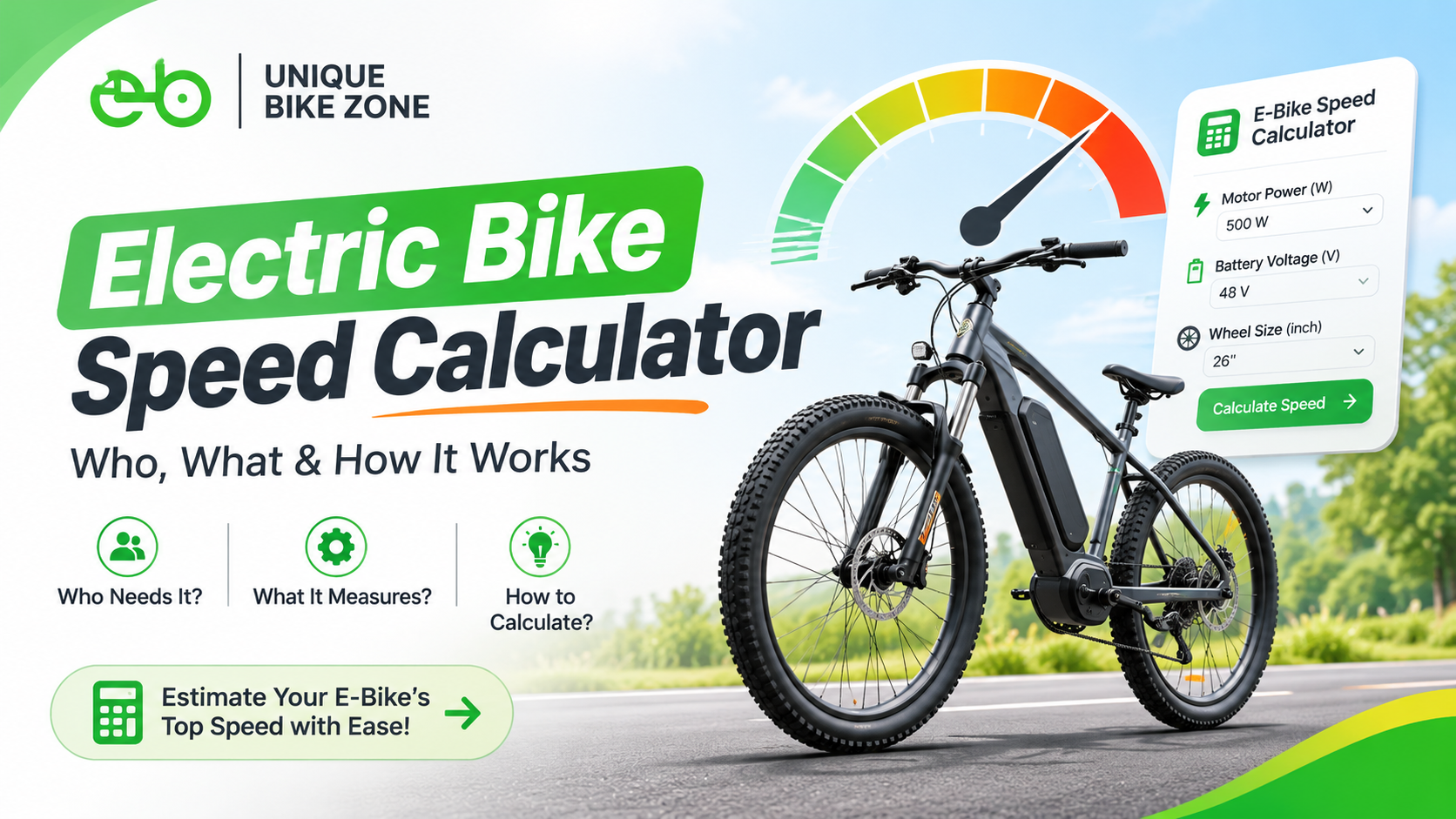


Most riders think their electric bike’s top speed is whatever the motor’s wattage rating suggests. Wrong. A 750W motor doesn’t automatically mean 25 mph. A 1000W system doesn’t guarantee 30 mph. The actual speed your electric bike can reach depends on a web of linked factors – voltage, wheel diameter, terrain, your weight, controller settings, and actual friction losses that no spec sheet mentions. This is why an electric bike speed calculator exists. It’s not a gimmick. It’s the fastest way to stop guessing and start understanding what your bike can actually do.
How Does An E-Bike Speed Calculator Determine Your Top Speed?
An e-bike speed calculator works by taking the physics of electric propulsion and flipping it into reverse. Instead of asking, “If I ride at this speed, how much power do I need?” it asks, “If I have this much power, what speed can I reach?” The core math is simpler than you’d think, but the variables that feed into it are where things get granular.
At its foundation, an electric bike’s speed is governed by the relationship between motor power (watts), the voltage pushing through the system (volts), wheel size, and the resistance forces fighting against motion – rolling friction, air drag, drivetrain losses. A calculator takes those inputs and spits out a theoretical maximum. But here’s the thing: theoretical and real are cousins, not twins. A calculator gives you the speed your bike can achieve under ideal conditions – flat ground, no wind, optimal efficiency. Real riding happens in reality, which is messier.
The reason this matters is simple. You’re about to drop serious money on an e-bike, or you already have, and you want to know if it’s fast enough for your commute, your weekend rides, your life. You don’t want to guess. You want to know.
What Factors Influence Electric Bicycle Top Speed Calculations?
Motor wattage is the headline number, but it’s not the whole story. A 500W motor paired with 24 volts behaves differently than a 500W motor running on 48 volts. The voltage determines how much current the motor can draw and how efficiently it converts electrical energy into rotational force. Higher voltage means the motor can spin faster at the same wattage.
Wheel diameter is the silent multiplier. A 29-inch wheel covers more ground per rotation than a 20-inch wheel. Same motor speed, different top speed. The gear ratio – how many times the motor spins for each wheel rotation – amplifies or reduces this effect. A direct-drive hub motor on a 29-inch wheel will hit higher speeds than a geared motor on a 20-inch wheel, even if the wattage is identical.
Rider weight and cargo weight matter because every pound requires energy to accelerate and maintain speed. A 150-pound rider will reach higher speeds than a 250-pound rider on the same bike, all else equal. Terrain is the reality check. Flat pavement is the calculator’s best-case scenario. Hills, sand, gravel, and wet conditions all eat speed. A calculator assumes ideal conditions unless you tell it otherwise.
Controller settings and pedal assist level are often overlooked. Some controllers are programmed to limit current draw or cap speed at a certain threshold for legal or safety reasons. In pedal-assist mode, your pedaling power combines with motor power, which can push speeds higher than the motor alone would achieve. Throttle mode, by contrast, relies purely on the motor.
Why Do E-Bike Speed Estimates Vary Between Different Calculators?
Not all calculators use the same formula. Some use simplified physics (basic power-to-speed conversion). Others add efficiency curves, drivetrain-loss percentages, plus aerodynamic drag coefficients. The more variables a calculator accounts for, the more accurate it tends to be – but also the more information you need to input.
Efficiency assumptions are where calculators diverge most. Some assume a motor is 85 percent efficient. Others use 90 percent. Some factor in drivetrain losses (chain friction, bearing drag) at 3 percent. Others at 5 percent or more. These small percentage differences compound. A calculator that assumes 90 percent efficiency will spit out a higher speed estimate than one assuming 80 percent efficiency, using the same motor and voltage.
Real-world versus theoretical is the deepest divide. Some calculators show you the theoretical maximum – the speed you’d hit on a perfect day, flat terrain, no wind, fresh battery, optimal weight distribution. Others try to predict actual riding speed, which is always lower. The difference between a calculator that says “your 750W system can do 28 mph” and one that says “you’ll probably hit 24 mph in real riding” is the gap between math and life.
What’s The Relationship Between Motor Watts And Electric Bike Maximum Speed?
Wattage doesn’t scale linearly to speed. A 1000W motor isn’t twice as fast as a 500W motor. The relationship is more subtle because speed depends on how fast the motor can spin and how efficiently it can transfer that spin to the wheels. But wattage does matter. More watts mean more power available, which translates to higher potential speeds, especially on hills or when accelerating.
A 250W motor is the legal limit in many jurisdictions. It’s enough to give you a noticeable speed boost – typically 18 to 22 mph depending on terrain, rider weight, and other factors. It’s not a speed demon, but it’s sufficient for casual commuting and light trails. A 250W e-bike feels like a normal bike with a helpful tailwind.
A 500W motor is the sweet spot for many riders. It offers real speed – typically 24 to 28 mph on flat terrain with an average rider – without being so powerful that handling becomes twitchy or braking becomes a concern. A 500W system accelerates noticeably faster than 250W and maintains speed on gentle hills without bogging down.
A 750W motor is where things get serious. These systems routinely hit 28 to 32 mph on flat ground, climb hills with authority, and feel genuinely quick. A 750W e-bike is no longer a bicycle with a motor. It’s a motor with pedals. Legal in some regions, illegal in others. Requires adequate brakes and handling skills.
A 1000W motor is the upper limit for most consumer e-bikes. These machines can exceed 35 mph on flat terrain and climb steep grades with shocking ease. A 1000W system is overkill for casual riding, although essential for serious mountain biking, heavy cargo transport, or riders who want maximum performance. The tradeoff is weight, cost, battery drain, and legal risk within jurisdictions having strict e-bike regulations.
How Does Battery Voltage Affect Your Electric Bike’s Speed Potential?
Voltage is the electrical pressure pushing current through the motor. Higher voltage allows the motor to spin faster at the same wattage. A 48V system will reach higher speeds than a 36V system with identical wattage because the motor has more electrical “push” available.
A 24V system is entry-level. Common on budget e-bikes and cargo bikes. It’s reliable and simple, but speed is modest – typically 15 to 20 mph depending on motor power and weight. A 24V system is adequate for slow, heavy hauling but not for speed-focused riding.
A 36V system is the most common voltage for mid-range e-bikes. It balances speed, efficiency, and cost. A 36V 500W motor will typically reach 22 to 26 mph. A 36V 750W motor can hit 26 to 30 mph. It’s the Goldilocks voltage for most recreational riders.
A 48V system is the performance standard. Higher voltage lets the motor draw more current without overheating, which means more power and higher speeds. A 48V 750W motor will outpace a 36V 750W motor. A 48V 1000W system is genuinely fast. Most high-end e-bikes use 48V or higher.
A 52V system is becoming more common on premium models. It’s a sweet spot – higher than 48V for better speed and power delivery, but not so high that battery cost and weight become prohibitive. A 52V system with a capable motor can reach the upper speed limits before air resistance and mechanical efficiency become the limiting factors.
Can Wheel Size Change Your Electric Bike Speed Calculations?
Wheel size directly affects how fast your bike travels at a given motor RPM. A 16-inch wheel makes more rotations per mile than a 29-inch wheel. Same motor speed, different ground speed. This is why folding e-bikes with small wheels feel slower despite having capable motors – they need higher RPM to achieve the same road speed as larger-wheeled bikes.
A 20-inch wheel is common on cargo bikes, folding e-bikes, and some city riders. A 20-inch wheel has a circumference of roughly 62 inches. To reach 20 mph, the wheel needs to rotate about 20 times per second. A 29-inch wheel has a circumference of roughly 91 inches. To reach 20 mph, it needs to rotate only about 12 times per second. The motor has an easier job on the larger wheel.
A 26-inch wheel is the traditional mountain bike size. Common on e-mountain bikes and some commuters. It’s a middle ground between small and large wheels – better speed than 20-inch, more nimble than 29-inch.
A 29-inch wheel is the modern standard for trail bikes and performance e-bikes. It rolls faster, maintains speed better over rough terrain, and requires less motor effort to achieve high speeds. A 29-inch e-bike will reach higher speeds than a 26-inch e-bike with the same motor and voltage.
Gear ratio amplifies or dampens the effect of wheel size. A motor with a 1:1 gear ratio (direct drive) spins the wheel at the same RPM as the motor shaft. A geared motor might have a 6:1 ratio, meaning the wheel rotates six times for every motor rotation. Direct drive is faster at the wheel. Geared is faster off the line but slower at top speed. A calculator needs to know both wheel size and gear ratio to predict speed accurately.
How to Use an Electric Bike Speed Calculator for Accurate Results
Using a calculator correctly starts with knowing which numbers to enter. Most calculators ask for motor wattage, battery voltage, wheel size, and rider weight. Some ask for more – drivetrain type, terrain, efficiency assumptions. The more precise your inputs, the more reliable your output.
The process is quite straightforward. Gather your bike’s specifications. Open the calculator. Input the numbers. Get your result. But the devil is in the details. A single wrong digit – saying 48V when your bike is 36V, or inputting 26-inch wheels when you have 29-inch – will throw the result off by 5 to 10 percent. For a bike with a 28 mph estimate, that’s a 1 to 3 mph error. Meaningful if you’re trying to decide if it’s fast enough for your use case.
Commence by gathering accurate specifications. Don’t guess. Don’t rely on memory. Look at your bike. Find the labels. Write down the numbers. This takes five minutes and eliminates most input errors.
Where Can You Find Your E-Bike’s Motor Specifications?
The battery label is usually the easiest place to start. Most e-bike batteries have a sticker or engraved label showing voltage and amp-hour capacity. It might say “36V 10Ah” or “48V 14Ah”. The first number is voltage. That’s what you need for the calculator.
The motor nameplate is often on the motor housing itself. If it’s a hub motor (in the wheel), look at the wheel. If it’s a mid-drive motor (in the pedal-crank area), check the motor case. The nameplate should show wattage. It might say “500W” or “750W” or sometimes “750W (peak)” if the manufacturer distinguishes between continuous and peak power. Use the continuous power rating if both are listed.
Manufacturer documentation is your backup source. The user manual, spec sheet, or website should list motor wattage, battery voltage, wheel size, and controller type. If you’ve lost the manual, search online for your bike model. Most manufacturers publish specs on their websites.
Frame labels and stickers sometimes show key specs. Look at the frame near the motor, the battery mount, or the headtube. Some brands print voltage and wattage right on the frame for quick reference.
What Measurements Do You Need Before Calculating Electric Bike Speed?
Motor wattage is essential. You need the continuous power rating, not peak. If your motor is rated “750W continuous / 1000W peak”, use 750W. Peak power is a burst rating, not sustainable, and won’t reflect your typical riding speed.
Battery voltage tells the calculator how much electrical pressure the motor has. 36V, 48V, 52V – get this right. A single volt doesn’t matter much, but being off by 12 volts (confusing 36V with 48V) will skew your result considerably.
Measure from the center of the wheel to the outer edge of the tire, then double it. Or look at your tire sidewall – it usually shows the wheel size (26″, 27.5″, 29″, etc.). If you’re unsure, measure the tire’s circumference (distance around the outside) and divide by 3.14 to get the diameter.
Gear ratio is needed if your motor is geared (most mid-drive motors are). A direct-drive hub motor has a 1:1 ratio. A geared motor might be 6:1 or 8:1. Check your motor documentation. This affects how fast the wheel spins relative to the motor shaft.
Pedal assist level is relevant if you’re calculating speed with human power included. A calculator might ask if you’re using throttle only, low assist, medium assist, or high assist. The higher the assist level, the more motor power is available, and the higher your possible speed.
What’s The Difference Among Theoretical And Actual E-Bike Speed?
The calculator gives you theoretical speed – the speed your bike can achieve under perfect conditions. Real-world speed is lower. Always. The difference between theory and reality is where physics meets friction, and friction wins.
Theoretical speed assumes zero rolling resistance, zero air drag, zero drivetrain losses, and a perfectly flat paved surface. It’s the speed you’d hit in a wind tunnel with an infinitely long, frictionless track. It’s useful as an upper bound of a ceiling. But you won’t hit it on your commute.
Real-world speed accounts for efficiency losses. Motor efficiency (typically 80 to 90 percent), drivetrain losses (2 to 5 percent), rolling resistance from tires on pavement, and air drag all conspire to slow you down. On a flat road with no wind, the difference between theoretical and real is maybe 5 to 10 percent. On hills or rough terrain, it’s much larger.
Why Is Your Actual Riding Speed Slower Than Calculator Estimates?
Because friction is the main culprit. Motor friction, bearing friction, chain friction, tire deformation – all consume energy that would otherwise go to forward motion. An 85 percent efficient motor wastes 15 percent of its power as heat, not speed. On a 750W motor, that’s 112 watts lost to friction. That’s power you can’t use.
Rolling resistance varies by tire type and surface. A slick road tire on smooth pavement has low rolling resistance. A knobby mountain bike tire on gravel has high rolling resistance. The calculator might assume road tires on pavement. If you’re riding gravel, your actual speed will be noticeably lower.
Terrain climbing is where the gap widens fastest. A calculator might give you a flat-ground speed of 28 mph. On a 5 percent grade, that same bike might only manage 15 mph. The motor has to work harder against gravity. Power that would go to speed goes to climbing instead. Steep hills can reduce your speed by 50 percent or more.
Headwinds slow you down. Air drag increases with speed. At 20 mph, air resistance is manageable. At 28 mph, it’s significant. A strong headwind can cut 3 to 5 mph off your top speed. A tailwind can add 3 to 5 mph. A calculator assumes no wind.
Battery aging reduces speed over time. A fresh battery delivers full voltage. After 500 charge cycles, it might deliver 95 percent voltage. After 1000 cycles, maybe 90 percent. Lower voltage means lower speed. A bike that hit 28 mph when new might manage 26 mph after two years of regular use.
Motor efficiency curves matter. A motor doesn’t run at peak efficiency over all speeds. It’s most efficient in a narrow RPM range. Outside that range, efficiency drops. A calculator might assume peak efficiency. Your actual riding might hit the motor at a less efficient RPM, reducing real-world speed.
How Does Terrain Affect Your Calculated Electric Bike Speed?
Flat terrain is the calculator’s baseline. Smooth pavement, zero elevation change, no obstacles. This is where you’ll come closest to hitting the calculated speed. But flat terrain is rare. Most real riding involves gentle rolling hills, which don’t stop you but do consume power.
Hills are speed killers. A 5 percent grade (a gentle hill) might reduce your speed by 30 to 40 percent. A 10 percent grade (steep) might cut your speed in half or more. A steep climb that the motor can barely handle might reduce your speed to 5 to 10 mph, regardless of what the calculator predicted.
Paved versus gravel makes a huge difference. Pavement is smooth. Tires roll freely. Gravel has rolling resistance – your tires sink slightly, dissipating energy. Riding the same bike on pavement versus gravel, you might see a 15 to 25 percent speed reduction on gravel.
Wet conditions increase rolling resistance and reduce traction. Wet pavement is slicker than dry pavement. Wet gravel is much slicker than dry gravel. Your actual speed will be lower, and your top speed might be limited by traction rather than motor power.
Elevation gain over a ride is cumulative. At 28 mph, a bike on a completely flat route might average 22 mph over a route with 500 feet of climbing. The motor spends time climbing, not cruising at top speed. For example Real-world average speed is always lower than top speed.
Are There Legal Speed Limits For E-Bikes You Should Know?
E-bike regulations vary wildly by country, state, and sometimes city. There’s no universal standard. What’s legal in California might be illegal in New York. What’s legal in the US might be illegal in Europe. Before you modify your bike or buy one expecting a certain speed, check your local laws.
The United States uses a three-class system. Class 1 e-bikes have pedal-assist only, no throttle, and are limited to 20 mph. Class 2 e-bikes have throttle, pedal-assist, or both, limited to 20 mph. Class 3 e-bikes have pedal-assist only, no throttle, and are limited to 28 mph. All three classes have a 750W motor limit. A Class 3 e-bike is legal in most states, but some states and cities restrict Class 3 from certain trails.
The European Union uses a 25 kph (15.5 mph) limit for pedal-assist e-bikes with motors up to 250W. That’s much more restrictive than the US Class 1 or 3 limits. An e-bike legal in the US might be illegal in Europe because it’s too fast or too powerful.
Other countries have their own rules. Canada allows up to 500W and 32 kph (20 mph) for pedal-assist. Australia allows up to 200W and 25 kph (15.5 mph). Some countries don’t regulate e-bikes at all. Before buying or modifying, research your specific location’s rules.
How Do Different E-Bike Classes Affect Your Speed Calculations?
Class 1 bikes are capped at 20 mph. If your motor could theoretically reach 25 mph, the controller limits it to 20 mph. The calculator should account for this. A 750W Class 1 bike won’t reach the theoretical 28 mph a 750W system might achieve – it’s capped by regulation at 20 mph.
Class 2 bikes are also capped at 20 mph, but they can use throttle without pedaling. This matters for speed calculation because you’re not adding human power. Pure motor power, limited to 20 mph. Same speed ceiling as Class 1, but different power delivery.
Class 3 bikes can reach 28 mph with pedal assist. No throttle (in most jurisdictions). The 28 mph limit is a hard cap. A 750W Class 3 motor can exceed 28 mph in theory, but the controller limits it to 28 mph. Your calculator should reflect this class limit.
Regional variations matter. Some states don’t recognize Class 3. Some cities ban all electric bikes above Class 1. Some trails allow only Class 1. A Class 3 bike legal for road riding might be illegal for trail riding in the same city. Your calculated speed is only relevant if you can legally ride at that speed in your area.
Can You Increase Your Electric Bike’s Top Speed After Calculation?
Yes. No. Maybe. It depends on your bike, your skills, your local laws, and your risk tolerance.
The easiest method is controller reprogramming. Many e-bike controllers have adjustable speed limits. If your bike is limited to 20 mph but capable of 25 mph, you might be able to reprogram the controller to remove or raise the limit. Some controllers have accessible settings. Others require specialized software and a computer connection. Check your bike’s manual or contact the manufacturer.
Motor modifications are more invasive. Some riders rewire motors or swap controllers to access higher power. This is where things get legally and mechanically risky. You might void your warranty. You might make your bike illegal to ride on public roads. You might overload components designed for lower speeds, causing them to fail.
Gearing changes can increase top speed. A smaller chainring or larger rear cog changes the gear ratio, allowing the motor to spin the wheel faster. But this reduces torque and climbing ability. A gearing change that boosts top speed from 25 to 28 mph might make hills nearly unrideable.
Pedal assist level affects speed differently. Some controllers let you adjust assist levels. Increasing the assist level means more motor power, which can push your speed higher. This is usually legal and doesn’t void your warranty, but it drains the battery faster.
What Are The Safety Considerations When Modifying E-Bike Speed Settings?
Brakes are the critical limiting factor. An e-bike designed for 20 mph has brakes sized for 20 mph. Pushing it to 28 mph or 30 mph stresses the brakes. They might not stop you as quickly. Braking distance increases with speed. A 20 percent speed increase might require 40 percent more braking distance. If your brakes aren’t adequate, you’re gambling with your safety and others’.
Handling changes at higher speeds. A bike that feels stable at 20 mph might feel twitchy at 28 mph. Geometry, weight distribution, and component tolerances all matter. Some bikes are designed for high speeds. Others aren’t. Pushing a casual commuter e-bike to maximum speed may reveal handling issues you didn’t know existed.
Warranty voiding is nearly certain. Most manufacturers explicitly void the warranty if you modify speed limiters or reprogram controllers. If something breaks, you’re on your own.
Insurance implications are real. If you’re in an accident and your e-bike is modified to surpass legal limits, your insurance might not cover you. You might be liable for damages. Check your insurance policy before modifying.
Component wear accelerates. Motor windings, bearings, drivetrain components, and tires all experience more stress at higher speeds. Your bike will need maintenance sooner. Parts will fail sooner. Higher speed means greater maintenance costs.
FAQs
What Is the Difference Between a 250W and 500W Electric Bike?
A 250W e-bike typically reaches 18 to 22 mph and suits casual commuting and light trails. A 500W e-bike reaches 24 to 28 mph and accelerates faster, climbs hills more easily, and feels noticeably quicker. The 500W system will drain the battery faster but offers significantly more performance.
How Accurate Are E-Bike Speed Calculators?
A well-designed calculator is accurate within 5 to 10 percent for theoretical speed on flat terrain. Real-world accuracy depends on how many variables you input and how closely your riding conditions match the calculator’s assumptions. Terrain, wind, and capability losses all reduce accuracy. Use the calculator as a guide, not a guarantee.
Can I Use An E-Bike Speed Calculator For Cargo Bikes?
Yes, but you need accurate cargo weight. A cargo bike’s speed depends heavily on total weight – bike, rider, and cargo combined. Input the total weight into the calculator. A cargo bike carrying 50 pounds of groceries will be significantly slower than the same bike unloaded.
Does Pedal Assist Increase Top Speed Beyond The Motor’s Capability?
Yes, but only slightly. Your pedaling power adds to motor power. A fit rider might contribute 200 to 400 watts of pedaling power. On a 750W motor, that could theoretically push speed from 28 mph to 30 or 31 mph. But the gain is modest – typically 2 to 4 mph – because your pedaling power is limited compared to the motor.
Why Does My E-Bike Feel Slower Than The Calculator Says It Should Be?
Actual conditions reduce speed. Hills, headwinds, rolling resistance from tires, motor efficiency losses, and battery deterioration all conspire to lower actual speed below theoretical speed. A calculator assumes ideal conditions. Your commute probably isn’t ideal. Expect your actual speed to be 5 to 15 percent lower than the calculator predicts.
How Does Temperature Affect E-Bike Speed?
Cold temperatures reduce battery voltage and motor efficiency. In freezing conditions, an e-bike might be 10 to 20 percent slower than on a warm day. Hot temperatures also reduce efficiency, though less dramatically. A calculator assumes room-temperature conditions. Extreme weather will lower your actual speed.
Is 1000W Electric Bike Worth the Cost for Speed?
A 1000W system is fast – typically 32 to 36 mph on flat terrain – but it’s overkill for most riders. It costs significantly more, drains the battery faster, and is illegal for road riding in many jurisdictions. A 750W system reaches 28 to 32 mph, which is fast enough for most use cases and legal in more places. A 1000W system makes sense for serious mountain biking or heavy cargo hauling, not just speed.
Can I Calculate My E-Bike’s Speed Without Knowing Exact Wheel Size?
You can estimate, but accuracy suffers. A 5 percent error in wheel size creates roughly a 5 percent error in speed prediction. If you don’t know your exact wheel size, measure the tire diameter or look at the sidewall marking (usually 26″, 27.5″, 29″, etc.). Spending two minutes to measure beats guessing and getting an inaccurate result.
Put The Throttle Down
You came here wanting to know how fast your e-bike can go. A calculator gave you a number. That number is useful – it’s a ceiling, a theoretical maximum, a reference point. But speed isn’t the whole story. What matters is whether your e-bike is fast enough for your actual riding, your terrain, your goals.
A 500W bike that hits 26 mph is more than sufficient for most commutes. A 750W bike that reaches 30 mph is genuinely quick. A 1000W system is overkill unless you’re climbing mountains or hauling cargo. The best electric bike isn’t the fastest one. It’s the one that fits your riding style, your budget, and your local rules.
A calculator removes the guesswork. You enter your motor specs, voltage, and wheel size, and you get a realistic estimate of what your bike can do. That estimate, combined with knowledge of actual conditions – hills, wind, your own fitness level – gives you a complete picture. You stop wondering. You know.
Want to know how fast your electric bicycle can travel? Instead of manually comparing specifications, use our Electric Bike Speed Calculator to estimate your bike’s speed and better understand its performance. Calculate your e-bike’s estimated speed and gain deeper insight into its performance capabilities. Enter your motor wattage, battery voltage, wheel size, and rider weight to get an accurate estimate of your bike’s top speed under ideal conditions, then adjust your expectations for actual factors like terrain, wind, and efficiency losses. Estimate your electric bike’s top speed in seconds, then decide whether that speed fits your riding needs.


Leave a Comment