
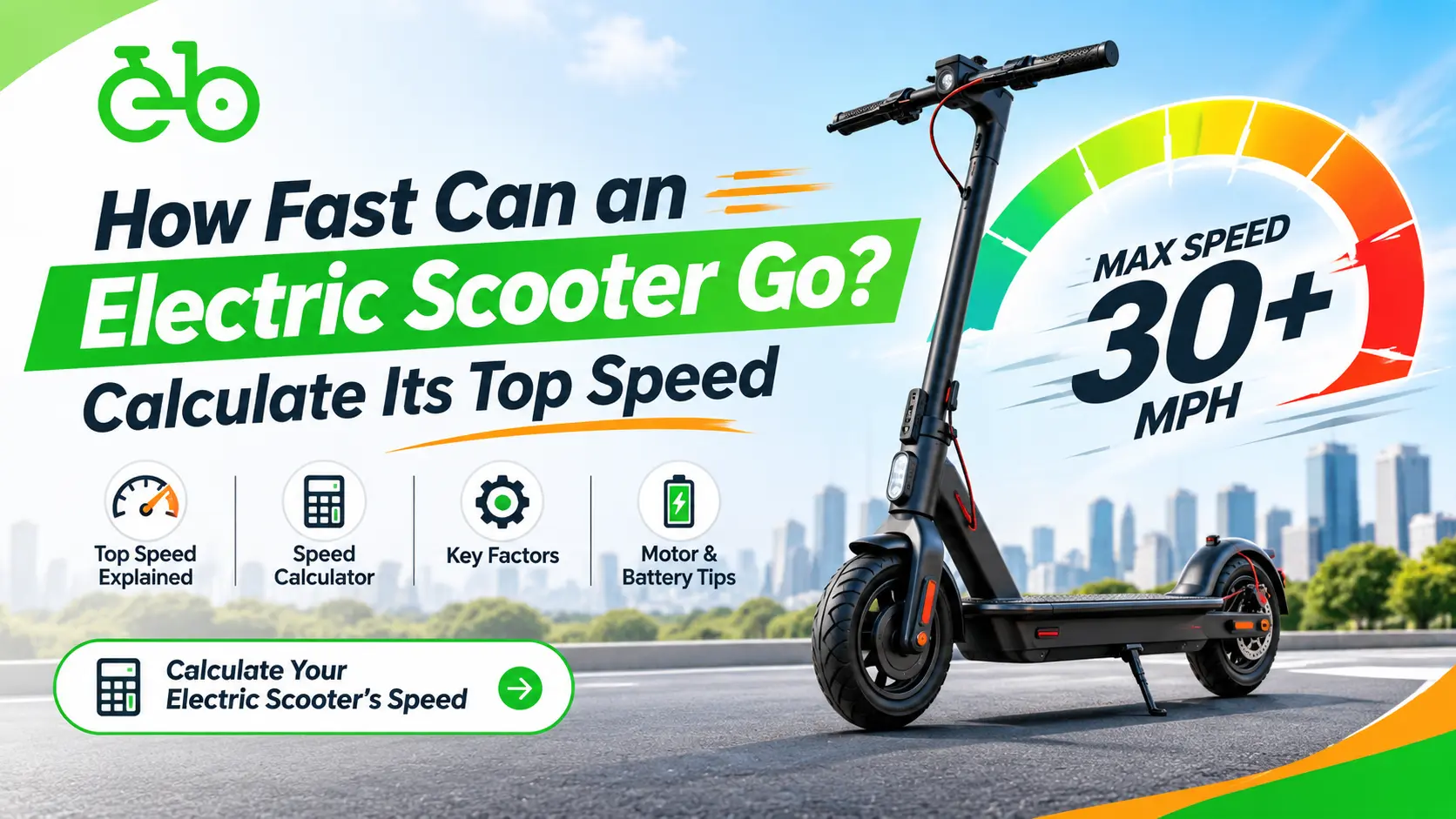


Most everyday electric scooters top out at about 15–25 mph (24–40 km/h). Lightweight commuter models may be limited to 15–20 mph, while high-performance scooters can exceed 30 or even 40 mph in controlled, private-use settings. However, the number printed on a product page is usually a best-case maximum, not the speed you will maintain on every ride.
Your actual electric scooter speed depends on motor output, battery voltage, controller settings, wheel size, rider weight, tire pressure, wind, hills, temperature, and the scooter’s speed limiter. Local law may also require a lower limit than the scooter’s mechanical capability. For a more specific estimate, enter your scooter’s specifications into the Unique Bike Zone electric scooter speed calculator.
How fast do normal electric scooters go?
Basically, normal commuter scooters are designed for short urban trips, bike paths where permitted, and last-mile travel.
Their advertised maximum is often around 15–25 mph. In stop-and-go traffic, a rider’s average moving speed is usually lower because of intersections, pedestrians, turns, surface changes, and cautious acceleration.
It helps to separate three numbers:
•Advertised top speed: the highest tested or claimed speed under favorable conditions.
•Cruising speed: the speed the scooter can hold comfortably without running at its limit.
•Average trip speed: the overall speed after including stops, turns, traffic, and hills.
Manufacturers commonly measure top speed with a light or medium-weight rider on flat ground, with a full battery and the highest riding mode selected. Apollo describes top speed as a best-case ceiling rather than a sustainable cruising speed. That is why a scooter listed at 20 mph may feel most comfortable at a lower speed in everyday use.
What determines an electric scooter’s maximum speed?
An electric scooter’s top speed depends on how well its motor can keep the wheels turning as resistance increases. The battery provides the power, while the controller manages how much energy reaches the motor. The motor then drives the wheel, moving the scooter forward. As speed increases, air resistance becomes stronger, making it harder for the scooter to go faster.
The motor’s nominal wattage is more useful for judging sustained performance than a peak-watt figure. Nominal power is what the motor can handle continuously, while peak power is normally a short burst for acceleration or a hill. Two scooters with the same nominal wattage can therefore have different acceleration and top-speed results because their motors, controllers, firmware, gearing, and tires are different.
Electric scooter speed by motor wattage
Wattage can suggest a scooter’s performance category, but it can’t guarantee a speed range. Treat the guide below as a buying framework, not a promise.
| Motor category | Typical use | What to expect |
| 250W | Lightweight commuting and flat routes | Lower acceleration and modest top-speed potential; best for lighter riders and gentle terrain |
| 350W | Everyday commuting | A practical middle ground for flat urban riding; performance depends heavily on the controller and rider load |
| 500W | Urban commuting and moderate hills | More acceleration reserve and hill-holding ability than many entry-level models |
| 750W | Performance commuting and steeper routes | Stronger climbing potential, but not automatically a high-speed scooter |
| 1,000W | High-performance commuting | Higher speed and acceleration potential when paired with a suitable battery and controller |
| 2,000W or more | Performance or off-road scooters | Can support much higher speeds, but model design, brakes, tires, rider skill, and legal restrictions become especially important |
How to calculate electric scooter top speed
A basic speed estimate starts with motor revolutions per minute (RPM) and wheel circumference. If you know the wheel RPM, use this formula:
Speed (mph) = wheel RPM × wheel circumference (inches) × 60 ÷ 63,360
If the motor RPM is given before gearing, divide it by the gear-reduction ratio first:
Wheel RPM = motor RPM ÷ gear ratio
For metric units:
Speed (km/h) = wheel RPM × wheel circumference (metres) × 60 ÷ 1,000
Example calculation
Suppose a scooter wheel turns at 600 RPM and the tire has a 10-inch diameter.
1.Calculate circumference: 10 × π = about 31.4 inches.
2.Multiply by wheel RPM: 31.4 × 600 = 18,840 inches per minute.
3.Multiply by 60: 1,130,400 inches per hour.
4.Divide by 63,360: about 17.9 mph.
That is a theoretical wheel-speed estimate. It assumes the wheel reaches 600 RPM under load and does not account for tire deformation, voltage sag, wind, hills, or electronic speed limits. In practice, the result may be lower.
A calculator is more useful when it accepts the actual motor RPM or manufacturer speed data. Wattage alone cannot be converted directly into a trustworthy top speed because watts measure power, not wheel rotation. If you only have motor wattage, voltage, wheel size, and rider weight, present the result as an estimate with a wide margin rather than a precise prediction.
How battery voltage affects electric scooter speed
Common performing scooter systems include 24V, 36V, 48V, 52V, 60V, and 72V. In general, a higher-voltage system lets a compatible motor reach higher RPM and provides more performance headroom. But the battery, motor, controller, wiring, and display must be designed to work together. Installing a higher-voltage battery is not a safe shortcut to more speed.
Voltage also changes as a battery charges and discharges. A full battery usually delivers stronger performance than a nearly depleted one, while voltage sag under heavy load can temporarily reduce power. Unagi explains that the controller regulates the motor and that battery voltage, state of charge, temperature, and discharge rate all affect how the system behaves.
Use these voltage categories as general buying context:
•24V: usually entry-level, low-speed, lightweight applications.
•36V: common on compact commuter scooters and many beginner models.
•48V: common on stronger commuters and performance-oriented scooters.
•52V: often used to provide extra performance headroom in performance models.
•60V–72V: generally associated with high-performance systems that demand better brakes, tires, thermal management, and rider control.
Read the voltage alongside amp-hours and watt-hours. Watt-hours = volts × amp-hours, so watt-hours are mainly useful for comparing energy capacity and expected range, not for predicting top speed.
Eight factors that affect real-world electric scooter speed
1.Motor power and efficiency. A motor that converts electrical energy efficiently can perform better than a less efficient motor with the same wattage rating.
2.Battery voltage and charge level. Performance can decline as the battery empties, especially under acceleration or on an incline.
3.Rider weight and payload. More total weight requires more force to accelerate and climb, and may lower top speed.
4.Wheel size and tire type. Larger wheels can roll over surface changes more smoothly, while tire pressure and tread affect rolling resistance.
5.Road surface and terrain. Smooth, level pavement is faster than rough pavement, gravel, grass, or a hill.
6.Wind resistance and riding position. Air resistance rises quickly as speed increases. A headwind can noticeably reduce speed.
7.Controller and speed limiter. Firmware may cap speed regardless of the motor’s theoretical capability.
8.Temperature and battery condition. Cold temperatures, an aging battery, and heat protection can reduce available output.
These variables explain why the same scooter can show different speeds on two rides. To compare performance fairly, test on the same flat route and use the same riding mode. Start with a similar charge level, and record speed with GPS rather than relying only on the dashboard.
How fast can an electric scooter go legally?
There is no single worldwide legal speed limit. Rules can differ by country, state, city, road type, scooter classification, and whether the vehicle is rented or privately owned.
For example, New York State says an electric scooter may have a maximum capability of no more than 20 mph on level pavement, but it is illegal to operate one above 15 mph under the state’s rule. In the UK, official rental-trial guidance sets a maximum rental speed of 15.5 mph, while privately owned e-scooters cannot be ridden on public land.
Before riding, check with your local transport or vehicle authority. Confirm rules for public roads, bike lanes, sidewalks, helmets, registration, insurance, age, and speed limits. A scooter that can reach 40 mph may be intended only for private land, even if it is sold online.
How to improve electric scooter speed safely?
Do not install an incompatible battery or controller to chase a higher number. Extra speed increases braking distance and demands more from the tires, frame, suspension, and brakes. Wear a properly fitted helmet and use additional protective equipment appropriate to the speed. U.S. Consumer Product Safety Commission recommends using a helmet and following posted speed limits for micromobility products.
Electric scooter speed versus electric bike speed
Electric scooters and e-bikes overlap in speed, but they are not interchangeable. A commuter scooter is compact, easy to store, and quick to deploy. An e-bike usually offers a seated riding position, larger wheels, bicycle-style brakes, and pedal assistance that can feel more stable over longer distances or rougher surfaces.
For many legal electric bike categories, motor assistance cuts out around a defined speed threshold, while scooter laws use different definitions and limits. A moderate-speed scooter favors portability and short trips; an electric bike may be more practical for longer rides or a seated position.
FAQs
How fast does a normal electric scooter go?
Most everyday commuter scooters are advertised around 15–25 mph, with actual trip speeds often lower. Rider weight, terrain, battery charge, traffic, and legal limits all matter.
Is 15 mph fast for an electric scooter?
Yes. Fifteen mph is a practical commuting speed and is the maximum allowed in some jurisdictions or rental programs. It still requires braking awareness, a clear route, and appropriate protective equipment.
How fast can a 500W electric scooter go?
A 500W scooter may be designed for the high teens or low 20s in mph, but there is no universal answer. Check voltage, controller limits, wheel size, rider weight, and the manufacturer’s test conditions.
How fast can a 1,000W electric scooter go?
A 1,000W model has higher speed potential than a basic commuter scooter, but firmware, gearing, voltage, and local compliance settings may limit its actual maximum. Treat the manufacturer’s rated speed as a best-case ceiling.
Does higher battery voltage make an electric scooter faster?
It can, when the motor and controller are designed for it. Higher voltage alone doesn’t guarantee more speed, and incompatible components can create safety or reliability issues.
Does rider weight affect electric scooter top speed?
Yes. A heavier total load usually reduces acceleration and may lower top speed, especially on hills or into wind. It can also increase energy use and braking distance.
Can an electric scooter reach 40 mph?
Some performance scooters can exceed 40 mph, but they are not equivalent to ordinary commuter models. They require appropriate brakes, tires, suspension, protective gear, and rider skill.
Why does my electric scooter go slower than advertised? A common question people ask
Because common causes include a low battery, cold weather, a headwind, underinflated tires, excess load, a speed-mode setting, a limiter, hills, rough pavement, and an aging battery. Compare GPS speed on a flat route before assuming the motor is faulty.
How can I calculate my electric scooter’s maximum speed?
Use the wheel RPM and circumference formula, or enter your scooter’s specifications into the Unique Bike Zone electric scooter speed calculator. Treat the result as an estimate, since real-world load and environmental conditions affect performance.
What is the legal speed limit for electric scooters?
It depends on where and how you ride. Check the current rules from your local transport or vehicle authority before using a scooter on public roads, bike lanes, or sidewalks.
Final thoughts
So, how fast can an electric scooter go? A typical commuter model reaches about 15–25 mph, while performance scooters can go much faster. The most useful estimate comes from the complete system, not one wattage number.
Compare nominal motor power, battery voltage, controller limits, wheel size, rider weight, terrain, and braking equipment. Then check the legal speed limit for your route. To turn those specifications into a practical estimate, calculate your electric scooter’s top speed.
References
[1] Apollo Scooters: Electric Scooter Specifications Explained
[2] Unagi: Electric Scooter Voltages—A Performance Guide
[3] New York State DMV: Electric Scooters and Bicycles
[4] GOV.UK: Using a Rental E-Scooter
[5] GOV.UK: Riding an Electric Scooter—The Rules
[6] U.S. Consumer Product Safety Commission: Micromobility Information Center


Leave a Comment